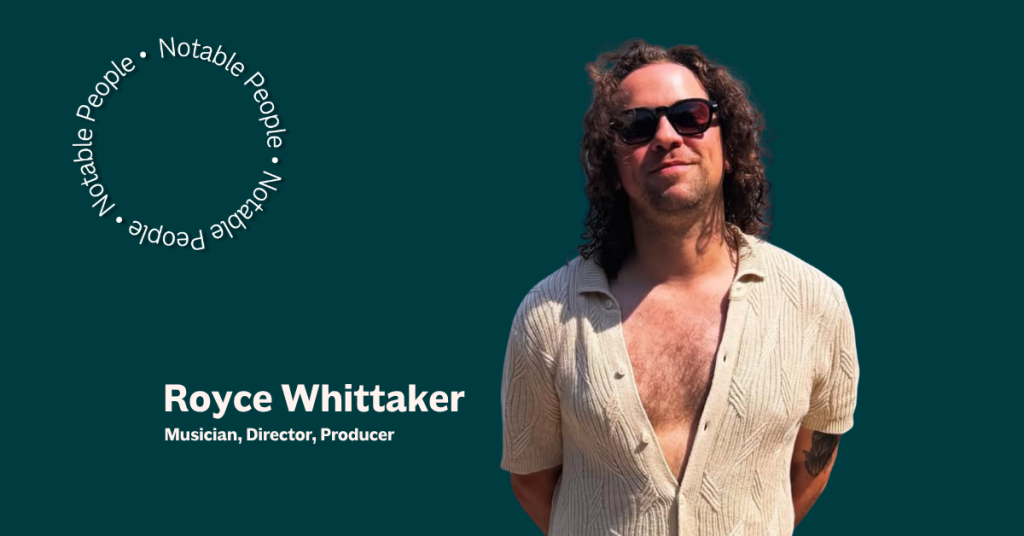
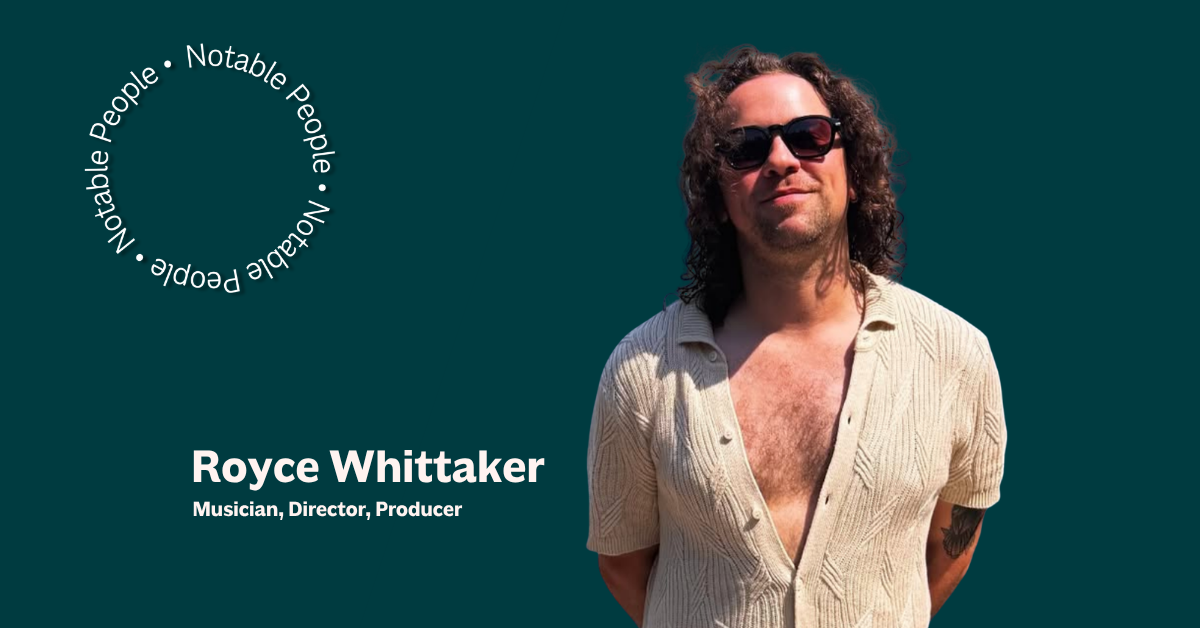
Originally from Vancouver and now based in Los Angeles, Whittaker has built a career that moves seamlessly between the studio and the stage. He began teaching guitar at just 15 and touring Canada by 17, eventually taking his musicianship onto some of the world’s biggest stages. His career has included years of touring with Canadian pop-rock band Marianas Trench, including contributing guitar to their 2015 album Astoria, before expanding further into musical direction, production, arranging and engineering.
More recently, Whittaker served as musical director for Daniel Caesar’s Superpowers World Tour, helping translate the Canadian R&B artist’s music into its live production. He has also toured as a guitarist with synthwave band The Midnight, alongside his wife and fellow musician Lelia Broussard.
Now, after years spent helping bring other artists’ visions to life, Whittaker is entering a more personal creative chapter. Alongside Broussard, he’s putting energy into Jupiter Winter—a project that brings together everything he’s learned from years of touring, producing and working behind the scenes, while giving the pair space to create something distinctly their own.
We had the opportunity to ask Royce Whittaker some questions about this next chapter!
- You’ve spent so much of your career behind the scenes helping bring other artists’ visions to life. How has working alongside such a wide range of artists shaped your own identity as a musician and the kind of artist you want to be?
From the space I’m in now, the realization that stands out is how the foundation of music starts with energy. I grew up obsessed with metal and aggressive, guitar-driven music. One of the most impactful lessons I learned was how similar that energy was to hip-hop and rap, for example, especially live. The 808 serves the same purpose that low-tuned, distorted guitars do. The drums are transient, heavy, and in your face. The vocal performances are aggressive and passionate. Everything works to support a message. Understanding that when I did allowed me to find my own voice in the world of music direction and music arranging, and use that influence to connect with artists in a unique way. I’m very fortunate to have worked with so many brilliant and significant artists across so many different styles, and the common ground has always been the authenticity behind the story and using your influences to your advantage. That has stuck with me in a big way, and reminds me that it’s all about expressing what’s within and not sacrificing that to try and latch onto a trend. It’s been historically intimidating to connect with my own expression in that way, but working with the artists I have has inspired me to find that path. I’m really excited to have a new project in the works that I can call my own, and it feels truly connected to my own expression, for the first time in my life.
- You started touring incredibly young, and your career has taken you from Vancouver to some of the biggest stages in the world. Looking back, was there a particular moment when you realized, “Okay, I can actually make a life and career out of music”?
It’s kind of funny – When I was a kid, my parents (rightfully so) were pretty apprehensive about me following the musician path. My Dad is a career musician and saw first-hand how brutally unforgiving that life can be, but I think to them it became apparent early on that they were fighting a losing battle with me. At an early age, I reconciled with myself that there just wasn’t another option, and I’d do my best to be as malleable as I could to always be working in music in some way. I started teaching guitar when I was 15, did my first tour across Canada and recorded my first professionally produced album with a band when I was 17, and almost didn’t graduate high-school (shoutout to my Grade 12 math teacher for giving me the bare minimum passing grade of 49.5% after I missed the last month of school). I was so passionate and excited, that the grind and slog and fear of being broke forever wasn’t enough to deter me. I was hungry for knowledge and was a sponge for any piece of information and situation I could put myself in front of. I still feel like that today.
- After years of working with and supporting other artists, what made this feel like the right moment to put your own creative project, Jupiter Winter, front and centre?
To me, Jupiter Winter is Lelia’s baby. I’ve always felt that my purpose is to support her in whatever she wants to do with it and be as much or as little of a part in it that feels right. Making music with her has only expanded my horizons as a musician, and she inspires me so much. She produced and played nearly everything on the new album and really believed in me to mix it and realize her vision. I don’t think I would’ve been able to do that had I not spent the last several years working with other artists in the way that I have, and truly understanding the blood, sweat and tears that go into an artist’s work and the journey songs take from the inception to the stage. I see the business of music and how artists can become a commodity. I really admire how Lelia isn’t afraid to be transparent about the journey and challenges that go along with it. I believe that is an art in and of itself, and important to show people, especially with this fight we’re in to maintain the human touch in music today.
- Creating a band with your wife adds a completely different layer to the experience. What have you learned about each other through making music together that you might never have learned simply as partners?
It’s a sensitive, beautiful and incredibly intimate thing. It’s really the closest you can be to someone, and I’m so lucky and grateful to have her in my life. Touring can be really hard on a relationship, and we’ve been so lucky to be able to tour together for the last few years with The Midnight. Having your person there with you every day, sharing the stage together, and supporting one another just makes things so much easier. I think we’ve been able to see sides of each other that we wouldn’t have had we not created together. We have a bigger picture of who we are as people, what makes us tick, and truly share a life together.
- When you’re both so creatively invested in the same project, how do you navigate moments when you have completely different instincts or ideas for where a song should go? Does the husband-and-wife dynamic ever have to stay outside the studio?
I’d be lying if I said it hasn’t been difficult at times. With how sensitive and vulnerable the nature of expressing yourself is, then combining two people’s expression, it’s bound to be tricky. One of my favourite moments from making “The Devil You Know” was on the song “Change Is Slow”. That was a song that I had started the music for years prior, that I felt really compelled to try and make work for the album. I was so hung up on this one little guitar counter-melody that Lelia just didn’t think worked with the song (she was totally right). Instead of just shutting it down, though, her songwriting and pop sensibilities saw the potential in how to make it work – her suggestion to tweak the rhythm saved the song and actually gave the song the feeling that I was chasing.
- You’re originally from Vancouver but have built much of your career in Los Angeles. How has being Canadian influenced the way you approach the music industry?
Growing up there–especially when I started playing in bands and recording/producing bands at the studio I ran with my Dad–everything was DIY. The opportunities were limited, and because of that, you grow up with a sense of being a “jack of all trades”, along with a strong sense of camaraderie. We were all in it together and tried to help each other out. Unfortunately, playing in, or moving to, the U.S. always felt “out of reach” and it still to this day is really hard to do, especially if you’re a musician starting out in Canada. I really credit Lelia for seeing the potential in me when we met, introducing me to her wonderful group of friends and music network and standing by me while I navigated uprooting my life, getting a work visa and moving to Los Angeles with her. That DIY attitude sticks with me today. Working in the music circles that I have, have showed me the importance of honing your craft and picking a lane to be exceptional in. That’s where the real professional value is that I’ve seen in people that I’ve worked under and been inspired by, and I don’t believe that the work is ever truly complete.
- After spending so much time living and working in the U.S., what do you find yourself missing most about Canada—and is there anything distinctly Canadian thing that you’ve carried with you into your life in Los Angeles?
Being here, I’ve missed countless birthdays, weddings, funerals, time with family, and the nature that I grew up with. This summer, I spent some time with my Mom and her partner, Peter, cruising on their boat around Desolation Sound – A part of B.C. I’ve wanted to explore since I was a kid. It’s been years since I had a proper vacation like that, and it was such a great recharge and spiritual refuelling that I desperately needed. It honestly wasn’t until I started touring and travelling and moving away that I really understood how beautiful that part of the country is and how it’s the only place like it on Earth. I do miss it dearly. In my home studio, I’ve got plaques on my wall from the album cycles I spent with Marianas Trench and one from the Daniel Caesar “Superpowers” tour I music directed. Both Canadian artists, and a nice reminder of the journey so far.
Read next: Jamie Milne of Everything Delish