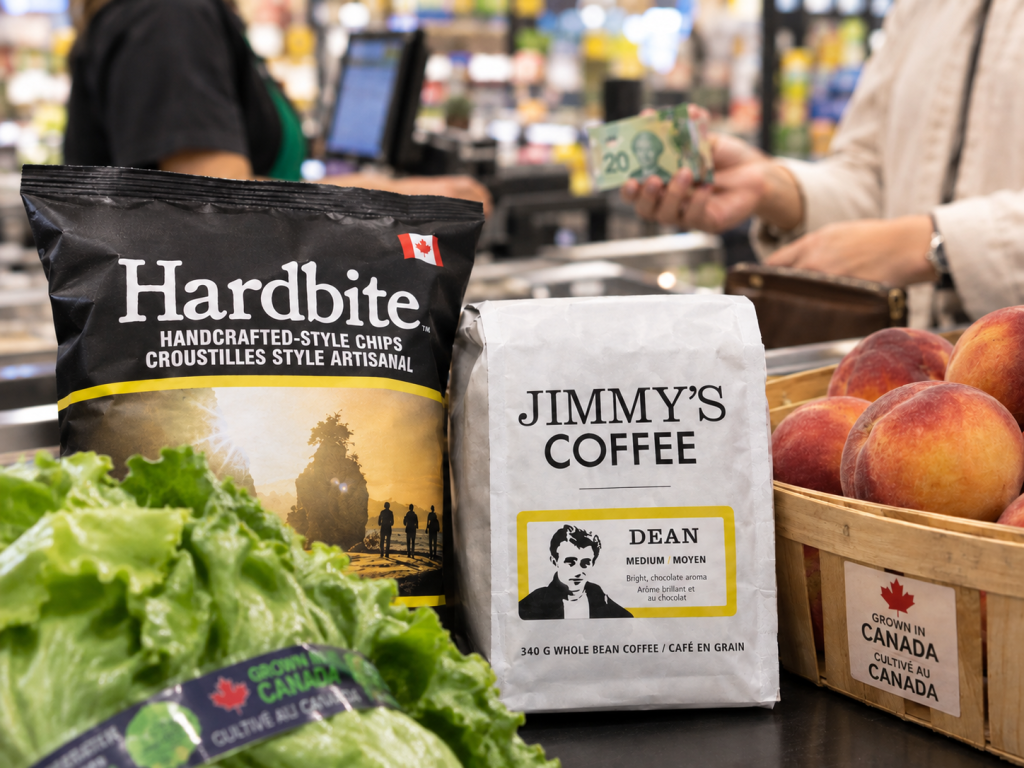
It was a perfectly fine weekend until I found myself singing deep into Canada and its economy. I was sipping my regular Jimmy’s Coffee order: a large cold brew with oat milk and two packets of Splenda. Jimmy’s is a Toronto-born coffee company that first opened on Portland Street in 2009 — local, familiar, and very Canadian.
I looked at the cup and suddenly wondered: when was the last time I actually had Starbucks? I could probably count the number of times on one hand this year. One was definitely a Pumpkin Spice Latte — some traditions are hard to break — but otherwise, it was either a treat I couldn’t say no to or a caffeine emergency. Setting aside the wider controversies surrounding the brand, Starbucks is ultimately a U.S.-based company I don’t feel particularly attached to. And since Canada-U.S. trade tensions have intensified, I’ve found myself becoming increasingly supportive of all things Canadian — from the country’s biggest companies down to its smallest startups.
I’m not alone. Across the country, consumers, businesses and communities are expressing support for Canada in all kinds of ways — through what they consume, what they promote and where they choose to spend their money.
The Trade Fight Is Reaching Main Street
The latest escalation came this summer. The United States imposed a 50% tariff on $27.6 billion worth of Canadian goods, effective August 22. Canada responded with counter-tariffs covering the same value of U.S. imports, with rates of 15%, 25% and 50% taking effect September 8. The measures are concentrated in sectors including steel and aluminum, dairy, appliances, agricultural equipment, pulp and paper, plastics and electronics.
That sounds very Ottawa-versus-Washington until you think about what happens next.
A small furniture maker may suddenly pay more for imported components. A construction company could face higher material costs. A retailer carrying American products has to decide whether to absorb an increase or pass it on to customers. And a Canadian manufacturer selling south of the border has to ask whether its product can still compete.
Those aren’t just trade statistics. They’re payroll decisions, hiring decisions and sometimes survival decisions for businesses in our own neighbourhoods.
Canadian Small Businesses Are Feeling It — From Retail to Sustainability
As of September 24, the Canadian Federation of Independent Business says small-business confidence has fallen sharply, with its long-term optimism index dropping nearly 10 points to 47.9. Businesses involved in international trade are also reporting weaker confidence than those operating only within Canada.
Statistics Canada tells a similar story. 32.2% of Canadian businesses expect U.S. tariffs to negatively affect them over the next 12 months, with manufacturing, transportation and warehousing, and wholesale trade among the most concerned sectors. And 27.4% of businesses say they have already passed at least some tariff-related cost increases on to customers.
The impact also reaches businesses working in sustainability. Green Planet Bio-Fuels, founded by Steve Hyman in 2008, collects used cooking oil and provides environmental services across Ontario and Quebec. The company’s own experience has pushed Hyman to talk about resilience differently: not simply surviving the latest round of tariffs, but strengthening Canadian supply chains and keeping more economic value within Canada. Green Planet’s business itself is rooted in turning a resource that might otherwise be discarded into something valuable — a fitting example of what greater Canadian self-reliance can look like. Green Planet Bio-Fuels Inc. serves nearly 10,000 food-service locations and facilities.
Canadians Are Betting on Canada, Too
If there’s one bright spot in all of this, it’s that Canadians seem increasingly willing to put their money where the maple leaf is.
In the second quarter of 2026, Statistics Canada found that 16.6% of businesses had changed their marketing to promote Canadian products. Another 14.2% reported increased sales of Canadian-made products, including an impressive 35.8% of retailers surveyed.
Suddenly, “support local” feels a little less like something printed on a tote bag and a little more consequential.
Choosing the independent Canadian clothing company, ordering from the neighbourhood food producer, sourcing from a domestic manufacturer or hiring a Canadian-owned service business helps keep money circulating through companies that employ Canadians, work with Canadian suppliers and contribute to communities here at home. As Hyman’s perspective at Green Planet suggests, supporting Canadian businesses is also about building resilience — making the country less vulnerable when trade conditions suddenly change.
That doesn’t mean we need to ceremoniously dump every American product in the garbage. Canada and the United States remain deeply connected economically. In July alone, roughly two-thirds of Canadian merchandise exports still went to the U.S., and the Bank of Canada stresses that international trade remains important to Canadian prosperity and consumer choice.
But businesses are adapting. The Bank of Canada says companies are adjusting supply chains to reduce tariff exposure and increasingly looking beyond the United States for growth.
Maybe Canadians can adapt, too.
I’ll probably have another Pumpkin Spice Latte at some point. I’m only human. But these days, when there’s a Canadian option sitting right beside the American one, I find myself thinking twice.
Choosing Canada may be personal. But millions of personal choices can become something much bigger.
Next read: OSAP New Policy Affecting Future Students