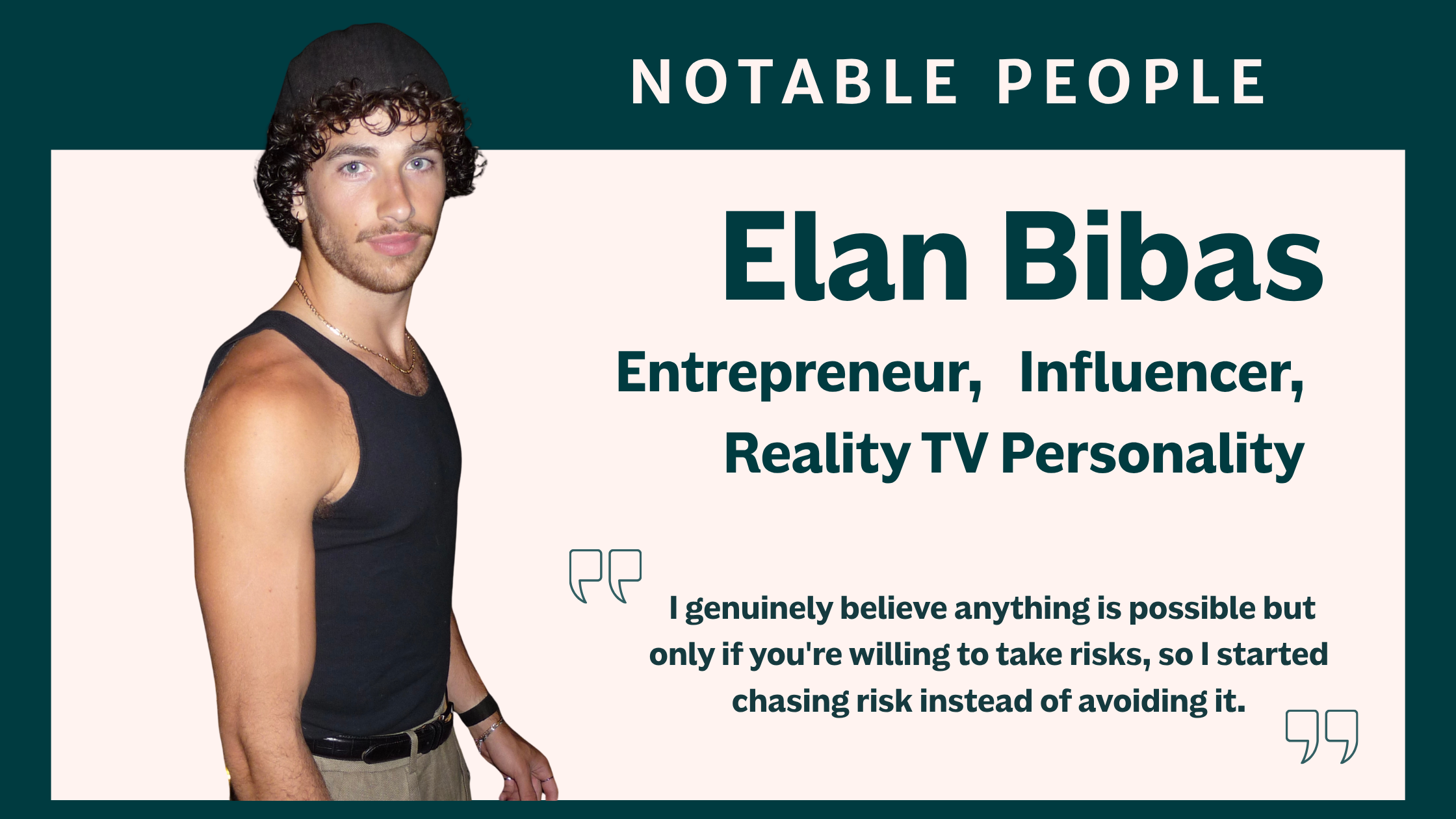
From computer engineering and tech entrepreneurship to reality television, Elan Bibas has never been one to stay in a single lane. The Canadian-born entrepreneur and Love Island USA alum has turned an unexpected leap into the entertainment industry into an opportunity to build something far beyond the screen, blending his passion for business, content creation, wellness and community. Now, with a growing platform and an entrepreneurial vision that spans industries, Elan Bibas is redefining what it means to build a career on his own terms — proving that sometimes the biggest opportunities come from taking the risks you never planned for.
1.Your career started in a very different world — computer engineering, tech consulting and entrepreneurship. Was entertainment ever something you imagined pursuing, or did Love Island completely change the trajectory you saw for yourself?
My parents used to tell me to pick a lane and stick to it. As I got older, I realized being multi-hyphenate wasn’t my weakness. It was my edge, and it’s the reason my life looks the way it does today.
I wanted to be a startup founder, so I became one. I wanted a run club, so I started one. I wanted a platform so I built one. Every experience I chased, every job I took, and every hobby I had was teaching me a skill I knew I wanted to learn and closing the gap between where I was and who I wanted to be.
I genuinely believe anything is possible but only if you’re willing to take risks, so I started chasing risk instead of avoiding it. I knew deep down that I wanted something bigger I just never, in a million years, pictured getting there would involve making out with strangers, half naked, on live TV.
2. You grew up in Canada and your first major television opportunity came through an American show. What has it been like navigating the entertainment industry as a Canadian, particularly when so many opportunities are centered in the U.S.?
When I got off Love Island USA, I was unexpectedly known as the Canadian Jewish bombshell. Overnight I had a platform and a lot of pressure. Some people wanted me to speak out. Others wanted me to stay quiet. And plenty of people had already decided who I was based on where I came from.
Reading some of what was written online about my identity was genuinely hard. But the flip side was incredible: I’ve never seen my communities rally the way they did. That support turned into speaking invitations at universities and institutions, where I spoke about what it’s like to be visible in a world that makes assumptions about you before it ever knows you.
When I speak now, I want people to leave feeling proud of who they are, and more willing to bet on themselves.
3. Going from a relatively traditional career path into the public eye is a huge shift. What was the biggest adjustment you had to make once people suddenly knew who you were?
The biggest adjustment has been the gap between how people see me and how I see myself. Someone watches a few scenes or videos and feels like they’ve figured me out. Maybe you’ve felt that too: someone hears what you do, finds out where you’re from, or sees you in one moment, and suddenly decides what kind of person you are. TV and social media put that feeling on a much bigger scale. I’ve had to learn that I can’t control everyone’s version of me, and I can’t let it control how I live.
Letting go of that has opened up a whole new way of living. My girlfriend always tells me, if life is a game, it’s like I figured out how to unlock the next level, and that’s exactly what it feels like. Most of us are taught what we should do, not what we want to do. For the first chunk of your life, the path is laid out for you. But you don’t have to keep following a path just because it’s what people expect of you. I’ve had to trust that life is happening for me, not to me, and focus on what I can control: showing up as authentically as I possibly can, on camera and off.
4. You were actually approached to be on Love Island rather than applying yourself. Looking back, what made you take that risk and say yes to something so far outside your existing career path?
It started with an Instagram DM asking if I was single and interested in interviewing for Love Island. I was single. I’d also never heard of Love Island. I went along with the interview, because why not do it for the plot? Then they actually offered me a spot, and I said no.
I don’t drink. I don’t really party. I don’t date multiple people at once. What could they possibly want with me? I’d also spent years building an engineering career, and I had no idea what stepping away from it would mean.
But I’d been telling myself I wanted to learn to take bigger risks. I’d watched people take swings that completely changed their lives. And here was my chance to take one, and I’d just said no.
Twenty-four hours, a meditation with my friend Alex, and one phone call later, the no became a yes. Next thing I knew, I was in Fiji, dating multiple women at a time (sorry Mom).
It didn’t come in the package I expected, but it was my big swing. It changed the entire course of my life, and I’d do it again in a heartbeat.
5. There can sometimes be an assumption that reality television is the end goal, but for you it seems to have become a starting point. How are you thinking about building a career that extends beyond the shows themselves?
Reality TV was an amazing opportunity, but it was never the end goal. The way I think about it is: the show gave me attention—what am I going to build with it?
This year, the creators on Forbes’ Top Creators list earned a collective $1 billion. That’s because creators aren’t just advertising for businesses anymore, they’re building them. Look at Alix Earle turning her acne journey into Reale Actives.
Content is an incredible way to connect with people, understand the problems they’re facing, and build something useful for them. My brother and I are putting this into practice at Bibas Group.
We’re looking to back companies like these as investors and advisors. My bet is that the biggest companies of the next twenty years will be built around media from day one.
As for what else is next for me, I can’t tell you exactly what I’m building just yet. I guess you’ll have to follow along to find out.
6. You’ve now experienced both American and Canadian reality television. Have you noticed any differences between the two industries — whether culturally, professionally or in the opportunities that come afterward?
On paper, they couldn’t be more different. One’s a dating show, the other’s a strategy game. But they’re more alike than you’d think. Both feel like summer camp. Everyone’s sleeping under the same roof, eating every meal together, and going through something so bizarre, and debatably traumatizing, that you come out understanding each other in a way no one else can.
When camp ends, those friendships come with you, and you never know where they’ll lead. For me, it’s been everything from running the NYC Marathon, to volunteering in Jamaica, LIV at 3 a.m., and even a Drake album release party.
None of that would have been on my bingo card.
7. When an opportunity comes your way now, what makes you say yes? Has your definition of a “good opportunity” changed since entering entertainment?
If it’s not a hell yes, it’s a hell no.
My life has changed a lot, but my morals haven’t. Before I say yes to any opportunity or partnership, I ask myself one question: Do I actually believe in this?
This year, I got the biggest hell yes of my life. I became a Brooks Running Partner.
Running has always been mine. It’s what I did for fun, for my sanity, for me. I wore Brooks because I loved them, not because anyone asked me to.
And now I get paid to do the thing I love most, running races all over the world, in the gear I’d already chosen, for the company I always wanted to run for. Younger me, growing up in Richmond Hill, would have never guessed this would be my life today.
At the end of the day, I try to do things that bring me closer to myself and make me feel more like me. Honestly, that’s the same reason I don’t drink. It takes me further from who I am. Running does the opposite. It brings me home.
8. What is one misconception people might have about you based on seeing you on reality television that doesn’t reflect who you are professionally or personally?
Warning: this might shock you. I don’t own a TV.
Yes, the guy who’s been on multiple reality TV shows doesn’t own a TV. Don’t get me wrong, I love a good show. But I’d rather not have a screen in my living room pulling me away from my life. Skipping the TV keeps me intentional, grounded, and present. It also keeps me locked in on my goals, because nothing makes me feel more alive than chasing something that scares me.
If I’m not in the mountains learning how to pull someone out of a crevasse, I’m probably making content, building my business, or getting a full nine hours of sleep. That last one never once happened on Love Island or The Traitors.
9. Has being Canadian influenced the way you approach your public persona or career — whether that’s how you communicate, the opportunities you pursue, or the way you want to represent yourself internationally?
Canada is home, and it always will be.
I’ve traveled more this year than ever before, but one of my favorite memories didn’t need a passport. It was road-tripping through the Canadian Rockies in a truck camper. Waking up surrounded by mountains. No schedule, no noise, just the road and some of the most beautiful landscapes on the planet.
But what really makes Canada special is the people. Canadians are some of the kindest, most genuine people you’ll ever meet, and that’s how I try to show up every day. Whether I’m on a start line or halfway across the world, I’m carrying a little bit of home with me. If people walk away thinking “that guy was kind, genuine, and worked his ass off,” then I’ve represented Canada the right way.
I couldn’t be prouder to call Canada home.
10. You’ve already taken several unexpected turns professionally. When you look five years ahead, do you see yourself primarily in entertainment, entrepreneurship, wellness, tech — or somewhere that combines all of them?
Five years from now, I see myself finally merging every hyphen of my life into something meaningful, not just for me, but for other people too.
Maybe that’s leading a business at the intersection of AI and health, using everything I learned in engineering and consulting to help people live better. Maybe it’s owning a farm in the mountains, somewhere quiet where I can slow down and build something with my hands. Maybe it’s both.
Whatever it looks like, I want to keep challenging myself, keep building, and keep experiencing life to the fullest. And hopefully, the kid from Richmond Hill who could never stay in one lane will look back and realize that was the whole point.
11. For another young Canadian looking at an unconventional career in entertainment, what do you wish someone had told you before you entered the industry?
The only thing scarier than taking a big risk is living with regret. What are you waiting for?
Follow Elan Bibas on Instagram (@elan.bibas) and TikTok (@embibas)
Subscribe to www.notablelife.com to get the latest news!