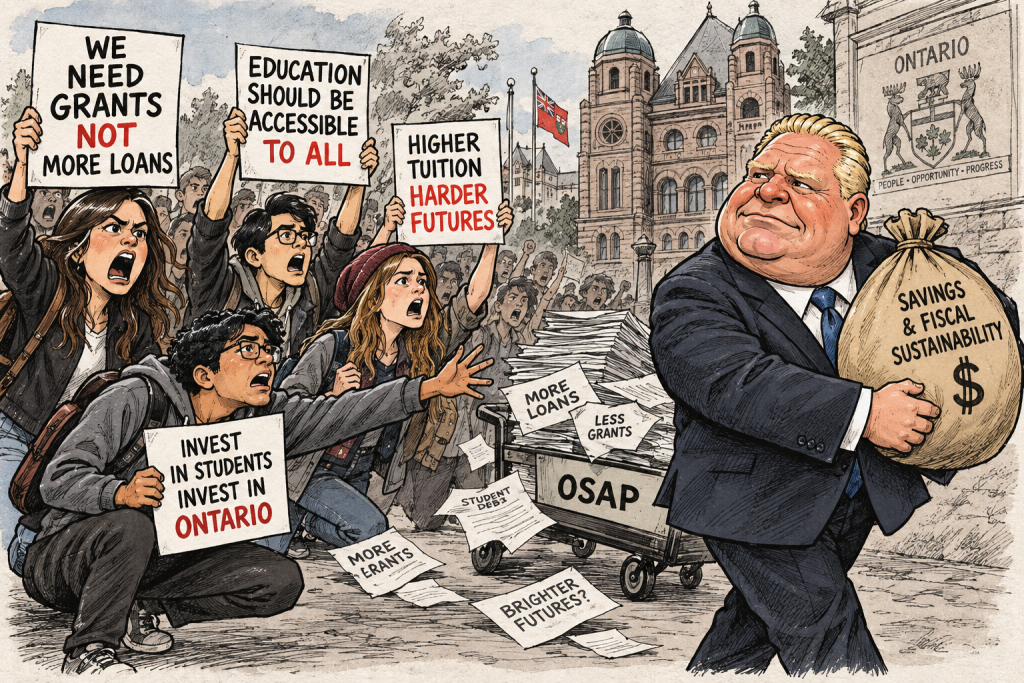
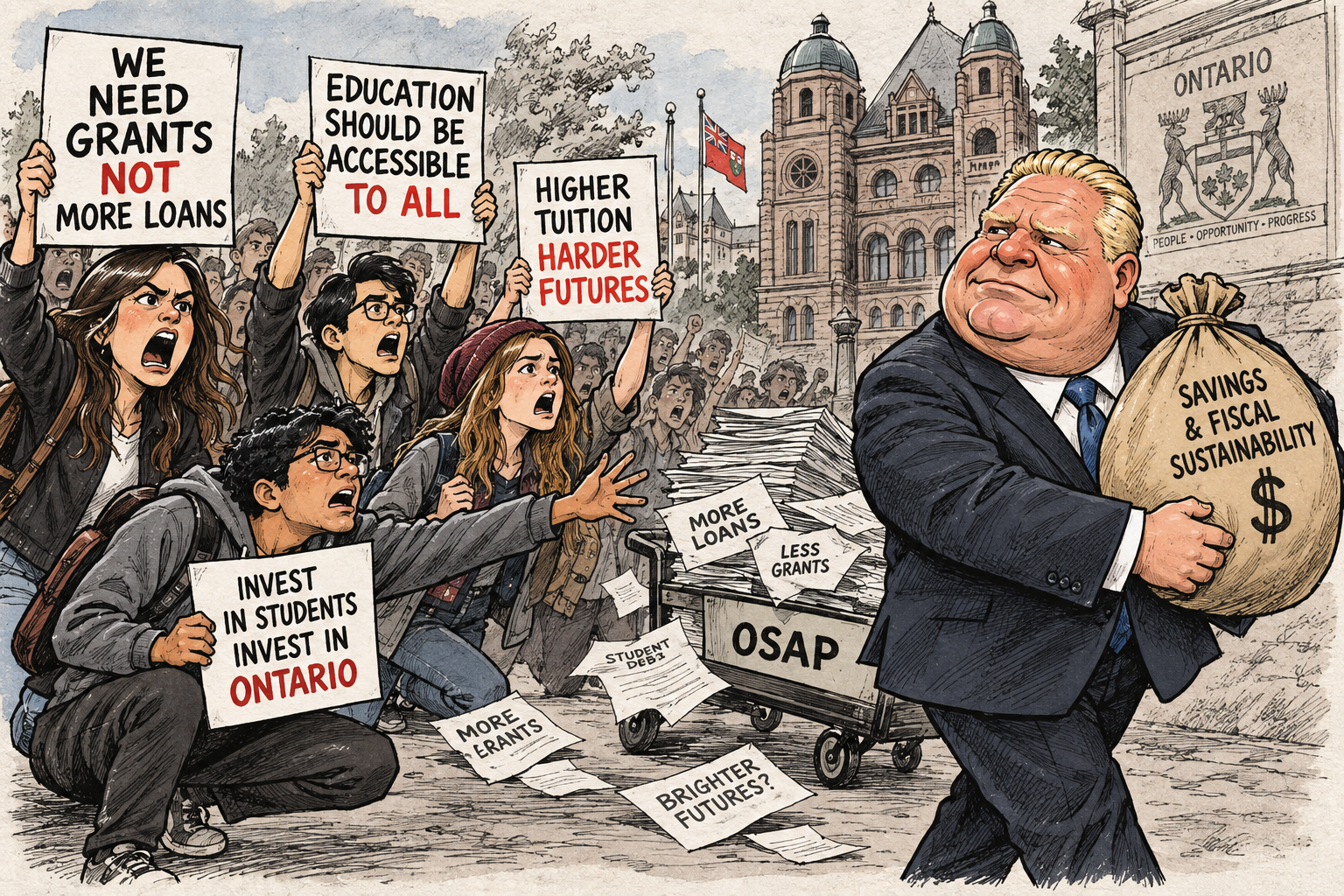
If you’re trying to fire-proof your career by upskilling for a fast-changing economy, postsecondary education is becoming an even bigger investment in Ontario — and the latest OSAP changes could leave some students borrowing much more.
In an increasingly brutal cost-of-living landscape, Ontario students have had, at least, the benefit of frozen domestic tuition at publicly assisted colleges and universities, and an OSAP system that leaned heavily toward grants — the kind of money you don’t have to pay back.
That era is changing.
In February 2026, the Ford government announced a major overhaul of the Ontario Student Assistance Program. For programs beginning on or after August 1, 2026, students can receive a maximum of 25 percent of their provincial OSAP funding as grants, with at least 75 percent delivered as loans. Under the previous framework, grants could make up as much as 85 percent of the funding package.
If you were funded under the 2025–26 academic year, the new structure doesn’t retroactively change that aid. But for students entering or continuing programs under the 2026–27 framework, borrowing could play a much bigger role in financing their education.
The fine print behind the OSAP changes
Private career college students face an even bigger shift. For study periods beginning on or after August 1, 2026, students enrolled at career colleges no longer qualify for the Ontario Student Grant, meaning their provincial OSAP assistance is loan-based.
The province says the move aligns with federal changes. Ottawa has also tightened eligibility for federal assistance at private, for-profit institutions. Most full-time students attending private, for-profit schools in Canada are no longer eligible for the Canada Student Grant for Full-Time Students beginning August 1, 2026, although exemptions apply to certain programs and students already receiving aid may qualify for transitional protection.
Then there’s tuition.
Beginning in fall 2026, publicly assisted Ontario colleges and universities can increase tuition by up to 2 percent annually for three years. After that, increases will be capped at either 2 percent or the three-year average rate of inflation — whichever is lower. It marks the end of Ontario’s long-running tuition freeze.
For students receiving less grant-based aid, having tuition increases arrive in the same academic year may feel like a financial double hit. However, the province says qualifying low-income students will have the additional tuition cost absorbed through an enhanced Student Access Guarantee, which can provide additional support when OSAP does not fully cover tuition, books and mandatory fees.
There’s another part of the student-loan picture worth watching: collections.
Separate from the 2026 OSAP restructuring, Ontario began phasing in Enhanced Collection Tools in the first quarter of 2025–26 for defaulted provincial OSAP, micro-credential and medical resident loans. The province says the measures were introduced after approximately $1 billion in student-loan debt had gone uncollected since OSAP began in 1975. Borrowers struggling with repayment can still apply for repayment assistance, but defaulted provincial loans may be subject to collection actions.
With loans now making up a larger share of provincial OSAP assistance, repayment is no longer just an afterthought in the conversation.
The government’s case for the OSAP changes
The province argues that the restructuring is necessary to make OSAP financially sustainable over the long term.
At the same time, Ontario is rolling out $6.4 billion in additional postsecondary funding over four years for colleges, universities and Indigenous Institutes. The funding model includes $1.7 billion for more than 70,000 additional seats in high-demand areas, including health care, STEM, education and skilled trades.
The government has also pointed to growing financial pressure on OSAP. In the legislature, the province said that pressure was projected to reach approximately $2.3 billion for fall 2026 and rise to $2.7 billion in the years ahead.
There’s also some historical context here.
Before Ontario substantially expanded grant-based aid in 2017, the province says the OSAP structure generally provided roughly 15 percent of assistance as grants and at least 85 percent as loans. The 2017 reforms shifted the system much more heavily toward grants. The 2026 changes don’t completely return Ontario to the pre-2017 structure, but they do move provincial assistance significantly back toward loans.
From the government’s perspective, that means asking students to finance a larger portion of their education through repayable assistance while putting substantially more public funding directly into postsecondary institutions.
Students push back against the OSAP changes
That argument hasn’t convinced many student organizations.
The Canadian Federation of Students–Ontario called the restructuring a “devastating blow for students” and helped organize a Queen’s Park protest against the changes. Students who participated expressed concern that losing grant funding could force them to take on substantially more debt — or reconsider whether they can afford to stay in school at all.
The University of Toronto Graduate Students’ Union, which represents more than 22,000 graduate students, described the change as a “structural reversal” of Ontario’s student financial-aid model and called on the province to reverse course.
The underlying concern is fairly straightforward: a grant doesn’t need to be repaid; a loan does. So even if the total amount of financial assistance available to a student remains substantial, changing how much of that aid becomes debt can change the financial reality waiting for them after graduation.
That’s particularly relevant at a time when affordability is already a major concern for students. A survey cited by the Ontario Undergraduate Student Alliance found long-term debt after graduation was the primary financial concern for 63.9 percent of surveyed university students.
Is the rest of Canada doing the same thing?
Not exactly — but comparing provinces isn’t as simple as ranking who gives students the most grants.
Each province uses different income thresholds, eligibility rules, loan limits, bursaries and provincial-federal funding arrangements. Quebec, for example, operates its own Loans and Bursaries Program rather than participating in the federal Canada Student Financial Assistance Program. Eligible Quebec students generally receive a loan first and may receive a non-repayable bursary if that loan does not meet their assessed financial need.
At the federal level, Ottawa is moving in a somewhat different direction from Ontario. For the 2026–27 school year, the federal government maintained the temporary 40 percent increase in Canada Student Grants compared with the pre-enhancement level. Eligible full-time students can receive up to $4,200 annually, while the federal student-loan limit remains temporarily increased from $210 to $300 per week of study. Federal Canada Student Loans also remain interest-free.
So Ontario isn’t alone in using loans as a central part of student financial aid. What makes the 2026 OSAP changes significant is the direction of travel: the province has deliberately shifted its own assistance away from grants and toward repayable loans at the same time that tuition is again permitted to rise.
Whether that proves to be a necessary sustainability fix or simply transfers more financial risk from government to students will depend on what happens next — particularly to student debt, postsecondary accessibility and the ability of low- and middle-income students to afford an education.
For students entering school now, however, one thing is already clear: understanding exactly how much of your OSAP funding is a grant — and how much you’ll eventually have to pay back — matters more than ever.