
When the Michelin Star first entered the culinary conversation, it represented something almost mythical: exclusivity, craftsmanship and an almost obsessive commitment to food.
A Michelin Star wasn’t simply a restaurant recommendation. It was a destination. A reason to get in the car, board a train or book a flight. The three-star designation was famously described as cuisine worth a special journey — and for generations, Michelin became one of the most powerful arbiters of what was considered exceptional dining.
But more than a century after the Guide was first published, Michelin has become something much bigger.
The Guide now spans more than 60 destinations, with thousands of restaurants across the world receiving stars, Bib Gourmands or recommendations.
And that raises an increasingly interesting question:
Has Michelin become too big to be as exclusive as it once was?
What exactly does a Michelin Star mean?
Let’s start with the basics.
A restaurant included in the Michelin Guide has been visited and selected by Michelin’s inspectors as worthy of recommendation. That is an accomplishment in itself — but it does not necessarily mean the restaurant has received a Star.
A Michelin Star is specifically awarded for the quality of the cooking.
Michelin says its inspectors assess restaurants using five criteria: the quality of the ingredients, mastery of cooking techniques, harmony of flavours, the personality of the chef expressed through the cuisine, and consistency over time and across the menu. Inspectors dine anonymously, pay their own bills and decisions are made collectively.
The hierarchy is simple:
- One Star: High-quality cooking, worth a stop.
- Two Stars: Excellent cooking, worth a detour.
- Three Stars: Exceptional cuisine, worth a special journey.
Then there is everything around the stars.
Bib Gourmand recognizes restaurants offering good food at good value, while the Green Star recognizes restaurants Michelin considers leaders in sustainable gastronomy. There are also restaurants that are simply recommended by the Guide without receiving one of those distinctions.
In other words:
Every Michelin-starred restaurant is in the Michelin Guide. Not every restaurant in the Michelin Guide has a Michelin Star.
So far, so straightforward.
But the more interesting story is what happens when we look behind the red book.
Is Michelin still as prestigious as it used to be?
This is where things get complicated.
Michelin’s expansion has undoubtedly made the Guide more accessible. What was once a relatively concentrated European institution has become a global brand, with new destinations continually joining the system.
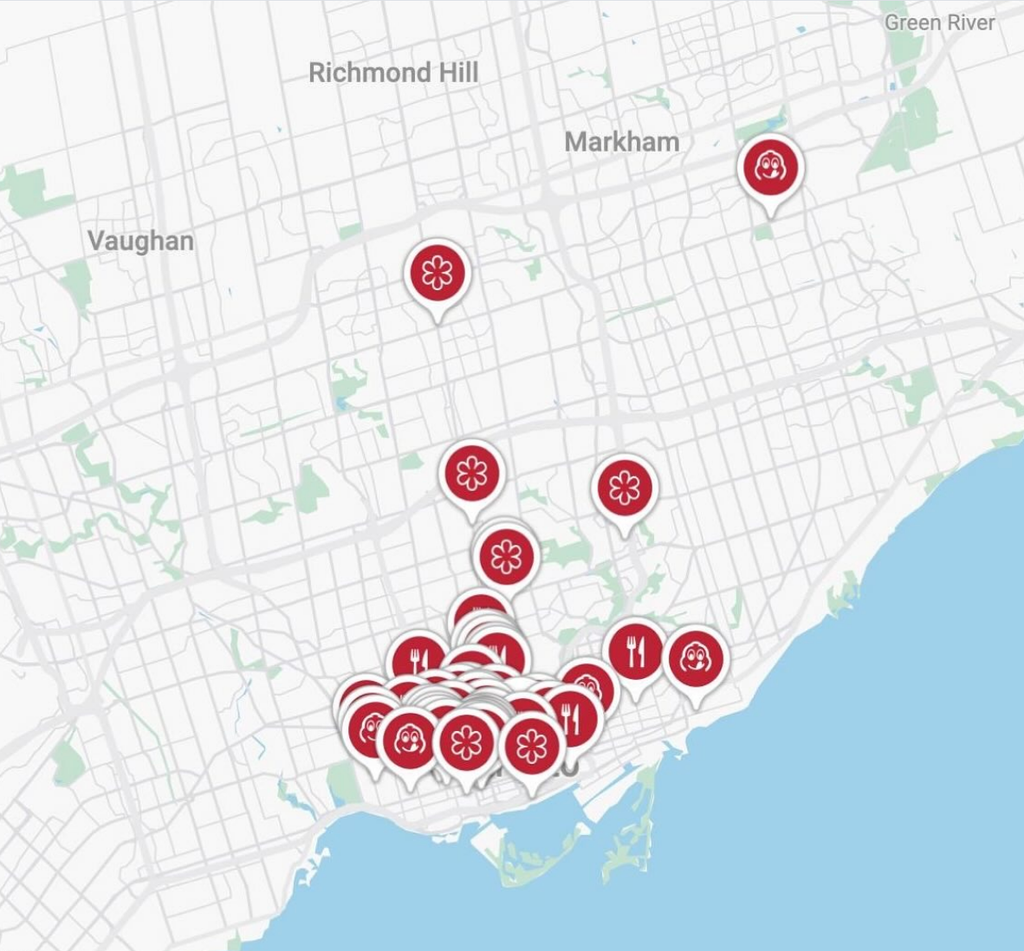
Toronto became the first Canadian Michelin destination in 2022. Vancouver followed that same year, Québec in 2024, and Michelin has continued expanding into new North American markets.
On one hand, that expansion can be viewed as a democratization of the Guide. Great restaurants are no longer confined to a handful of traditional culinary capitals.
On the other hand, it raises a legitimate question:
Does a distinction become less rare — and therefore less prestigious — when the institution awarding it is everywhere?
Michelin would argue that the answer is no. Its methodology is designed to remain consistent regardless of geography, and the company says the same five criteria are applied internationally.
But the perception of prestige is not necessarily governed by methodology alone.
When Michelin arrives in a new city, the announcement itself becomes an event. Tourism organizations promote it. Restaurants celebrate it. Cities use it to market themselves. Media outlets build coverage around it. Consumers begin using “Michelin” as shorthand for culinary credibility.
Which brings us to perhaps the most uncomfortable question:
Who benefits from Michelin being there?
Michelin and the tourism machine
Michelin has always had an interesting relationship with travel.
The Guide was originally created to encourage motorists to travel — and, naturally, to use more Michelin tires along the way. Over time, its restaurant recommendations became arguably more influential than its original automotive purpose.
That travel DNA still matters.
When Toronto became Canada’s first Michelin destination, Destination Toronto partnered with Destination Ontario and Destination Canada to bring the Guide to the city. Destination Toronto openly described Michelin as a powerful marketing tool that could help position Toronto as a must-visit culinary destination.
And there is an important distinction here.
Tourism organizations can help bring Michelin to a destination. They do not, according to Michelin and the City of Toronto, determine which restaurants receive recognition.
Michelin says its inspectors remain independent and anonymous, while Toronto’s announcement stated that the city has no input into the restaurants assessed or the outcomes.
So perhaps the better question isn’t whether a tourism board can simply buy a Michelin Star — there is no evidence to suggest that it can.
The more interesting question is:
What does a city gain by paying to participate in the Michelin ecosystem in the first place?
Because Michelin is no longer simply a restaurant guide. It is destination marketing.
Toronto’s tourism leaders have explicitly connected the Guide to attracting visitors, strengthening the city’s culinary reputation and encouraging investment in its restaurant ecosystem.
And that makes Michelin simultaneously a culinary authority and a very effective tourism engine.
Are Michelin restaurants actually better?
Here’s the question nobody wants to ask at the dinner table.
Are Michelin-starred restaurants actually better than the restaurants you already love?
Not necessarily.
And that’s not really a contradiction of the Michelin system.
Michelin is evaluating restaurants according to a particular framework. It is not measuring whether you personally will have the most memorable night of your life.
A technically extraordinary meal can still leave you cold.
A tiny neighbourhood restaurant with plastic chairs can deliver the meal you remember for ten years.
A tasting menu can be flawlessly executed without necessarily making you gasp.
And a restaurant can be revolutionary, technically brilliant and deeply important to the culinary world while still not being your favourite place to eat.
Michelin itself says that décor, style and formality do not determine whether a restaurant receives a Star. The Star is about what is on the plate.
That distinction matters.
Because sometimes what diners interpret as “Michelin quality” is actually the entire experience surrounding the meal: the room, the service, the wine program, the plating, the theatrics, the reservation difficulty and, perhaps most importantly, the knowledge that somebody has already declared the restaurant important.
Prestige can change the way we experience food.
And that may be one of the most fascinating things about Michelin.
The Michelin effect
There is no question that Michelin recognition can have real economic consequences.
Research examining Michelin-starred restaurants has found that recognition can allow restaurants to charge higher prices, while other research has found that Michelin-starred restaurants can operate on surprisingly low margins because of their demanding cost structures. A 2023 study of Spanish restaurants found that Michelin-starred restaurants could benefit from increased profitability, but also highlighted the high costs associated with food and especially labour.
In other words, the Star can be both an asset and a burden.
Winning one can bring attention, reservations, pricing power and international credibility.
But maintaining one means maintaining the standard.
Every year.
Michelin reassesses starred restaurants annually and can remove a Star if it determines that the cooking no longer meets the required standard.
Imagine building your entire restaurant around being exceptional — and then discovering that “exceptional” has become the minimum expectation.
The downside of winning
For diners, a Michelin Star sounds like a dream.
For restaurant owners, it can be considerably more complicated.
A Star can create enormous demand. That sounds wonderful until the kitchen has to handle substantially more covers without compromising the food that earned the recognition in the first place.
There can also be pressure to maintain consistency, invest in ingredients and staffing, and preserve an increasingly demanding standard of execution.
Research has found that Michelin-starred restaurants can face significant cost pressures and, in some cases, low profitability despite the prestige associated with the award.
And then there is the psychological pressure.
Once a restaurant has a Star, diners aren’t simply arriving for dinner.
They’re arriving expecting a Michelin dinner.
The expectation has already been set before the first bite.
That can be an extraordinary marketing advantage.
It can also be a very expensive promise to keep.
So… is Michelin notable or not?
This is probably the wrong question — which may be exactly why it’s worth asking.
Michelin is still notable.
Its inspectors are professionals, its process is structured, its criteria are clearly defined, and the organization has spent more than a century building a reputation around restaurant criticism and anonymous inspection.
But notable does not necessarily mean infallible.
A Michelin Star is not an objective declaration that a restaurant is one of the best places you will ever eat.
It is recognition from one particular institution, using one particular methodology, for one particular definition of culinary excellence.
And that distinction matters more than ever as Michelin expands.
Perhaps the real evolution isn’t that Michelin has become less legitimate.
Perhaps it is that we have become more sophisticated about what legitimacy means.
We can appreciate the skill required to earn a Star while still asking whether we enjoyed the meal.
We can recognize the significance of a restaurant appearing in the Guide without pretending that being listed is equivalent to receiving a Star.
We can understand that tourism organizations have a vested interest in promoting Michelin while recognizing that the restaurant selection itself is intended to remain independent.
And we can accept that sometimes the $300 tasting menu is extraordinary — and sometimes the $35 neighbourhood dinner is the meal we actually want to tell everyone about.
Because at the end of the day, Michelin can tell us what its inspectors think is exceptional.
It can’t tell us what we’re going to love.
And maybe that’s where the mystique ends.
So the next time someone tells you they’re taking you to a “Michelin restaurant,” there is only one appropriate follow-up:
“Michelin-starred… or Michelin-listed?”
Because apparently, even dinner comes with fine print.