
Just to review —Gen Alpha slang terms brain rot and doomscrolling refer to a decline in mental and critical thinking due to excess consumption of low-quality, fast-paced online content.
You open TikTok for “five minutes.” Suddenly it’s 2 AM. Your work isn’t done, your attention span feels destroyed, and somehow your brain feels both overstimulated and empty at the same time. Welcome to the digital age.
Today, technology has advanced to the point where almost everyone has access to social media and AI. These tools have made learning, communication, and creativity faster than ever before.
However, over-reliance on these tools is affecting our attention spans, habits, and ability to enjoy everyday life offline. Additionally, because technology has advanced so quickly, most people haven’t been able to step back and properly evaluate these effects.
This concern becomes even more serious with the rise of “iPad babies” — children exposed to constant screen stimulation before developing focus, communication, and independent problem-solving skills. Therefore, it is essential to build habits early that reduce these long-term mental and physical effects.
The real impact of brain rot
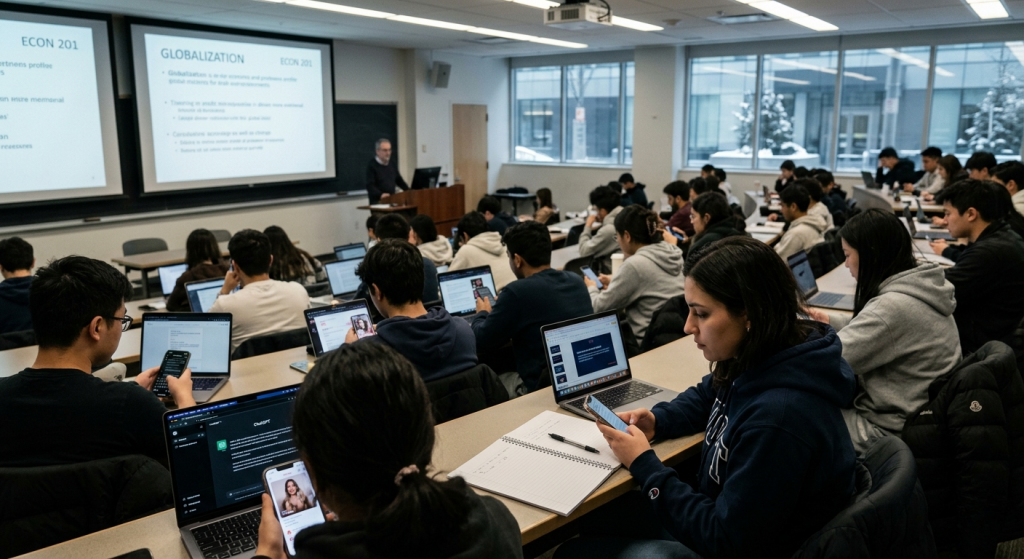
Every day, my friends and family tell me the same thing: “I didn’t do anything, I just scrolled on…” TikTok, YouTube, Instagram, or Facebook. Despite our goals and responsibilities, we struggle to stay focused because app developers intentionally design distraction into almost every platform we use. Even at UofT, professors now limit classroom device use and require students to disclose AI in assignments because nobody can avoid these tools anymore.
According to Meltwater’s 2025 media report, Canadians over 16 spend over six hours online daily, including nearly two hours on social media alone. While this pervasive digital tech and AI can foster inspiration and collaboration, it has also weakened vital critical thinking skills; many young adults now struggle to write essays, read textbooks, or conduct research without digital crutches, ultimately eroding their capacity for deep focus and the valuable process of trial and error.
In turn, many people have attempted to delete their social media and completely stop using AI. However, while this is seemingly a simple solution, it is unrealistic. In this digital age, social media is the main source to communicate with friends, keep updated with the news, and connect with trends/events. AI drives almost every digital platform today. From ChatGPT to Google to our personal devices, technology actively shapes our societal norms.

With AI now controlling most algorithms and content feeds, social media has become more personalized, endless, and addictive than ever before. This unpredictable low-effort scrolling has trained the brain to crave frequent mini dopamine hits—making real-world activities feel boring, unrewarding, and difficult to focus on.
A 2024 study linked social media addiction and its associated dopamine loops to a loss of executive functioning skills, including problem-solving, planning, and working memory. The American Psychological Association links brain rot and doomscrolling to poorer attention spans, weaker impulse control, and impaired inhibitory control.
Solution to brain rot
The problem isn’t technology itself — it’s losing control over how much of our attention it consumes. So the question is: How do we combat brain rot?
In the medically reviewed article from WebMD, the answer against brain rot is to take action to rewire your dopamine loops.
- Setting Limits: The first practice you should implement is learning how to set time limits and breaks. By using built-in digital wellness tools on your device and setting screen limits, you can build awareness of your addictions and give your apps a break.
- Train Your Attention Span: Another habit you can develop is to intentionally seek active engagement by reading long-form content, such as articles, books, or even textbooks. Slowing down and engaging with longer-form content helps retrain your focus and attention span over time.
- Practice Independent Thinking: In the digital age of AI and endless information, practicing self-education is more important than ever. Taking everything online at face value weakens critical thinking and originality, so it’s important to question what you see and do your own research.
Key Takeaway

Overall, social media and AI are powerful tools that help people connect, create opportunities, build communities, and share ideas faster than ever before. However, with all these possibilities, it is important to recognize how technology shapes our habits, attention spans, and daily routines — and to be more intentional about how we use it.
In a world designed to constantly capture your attention, learning how to control it may become one of the most important life skills of this generation.
Be sure to subscribe to our newsletter!