

Three days ago, I picked up my second EV–Sorry, BEV. B for battery. When I took delivery of my first, a Tesla Model X, in 2018, “EV” was a sufficient descriptor. Electric Vehicle. Easy. Now, we must wrap our heads around PHEV, EREV, HEV, NEV, FCEV….. WTFEV. The confusion extends throughout the EV market as a whole. On one hand, Tesla is printing money and making Elon Musk the richest guy in the world (recently, on my morning commute, I counted seven Teslas stopped at the red light with me). On the other hand, you have EV startups, such as Fisker, going out of business, while legacy automotive brands like Ford and GM are delaying or completely cancelling major EV projects.
The reality is that electronic vehicles are now a major market player. When I drove that Model X off the lot in 2018, it felt like I was buying-in to an experiment. EVs accounted for maybe 2% of new car sales worldwide. Today, one in four new cars sold is an e-vehicle. But E-vehicles market share varies dramatically, based on region. In China, well over 50% of new cars are EV, contrasting to around 10% in the USA. In Canada, we are somewhere in between, but also with big differences between provinces.
So, what to do if you need a new car? The current prices at pumps are definitely making it more appealing. But are we paying too much for the car to make ditching gas worth it? Is the infrastructure in place? Does this vehicle suit your needs?
For me, my wife was adamant that we must have it and wouldn’t entertain any variation other than a fully battery-powered car. She didn’t care about the nuances; she just wanted nothing to do with an ICE (internal combustion engine). So that made our decision simple. But for most people, there is more than ever to think about when buying a new car. Here are some points for Canadian car consumers to consider when they are looking at adding one to their driveway.
What Flavour of EV
“Electric vehicle” no longer means just one thing. Canadian buyers can choose from several different technologies, each offering a different compromise between electric driving, convenience and price.
BEV (Battery Electric Vehicle) — Runs entirely on a battery and electric motor, with no gas engine at all (e.g., Every Tesla model, Nissan Leaf, Kia EV9, Hyundai Ioniq 5).
- Positives: Zero tailpipe emissions, lowest running costs, quietest and smoothest driving experience, eligible for the widest range of incentives.
- Negatives: Highest purchase price, dependent on charging infrastructure for longer trips, cold Canadian winters can noticeably reduce real-world range.
PHEV (Plug-in Hybrid Electric Vehicle) — Combines a gas engine with a battery large enough to drive 30–80 km on electricity alone before the engine kicks in (e.g., Toyota RAV4 Prime, Ford Escape PHEV).
- Positives: Can handle daily commuting on electricity while still having a gas engine for longer trips or if you can’t charge reliably; no range anxiety.
- Negatives: More complex mechanically than a BEV (two powertrains to maintain), most of the “savings” only materialize if you actually plug it in regularly, smaller electric range than a full BEV.
HEV (Hybrid Electric Vehicle) — Uses a small battery and electric motor to assist a gas engine but cannot be plugged in at all; the battery charges itself through braking and engine power (e.g., Toyota Corolla Hybrid, Honda CR-V Hybrid).
- Positives: No charging required, no range anxiety whatsoever, meaningfully better fuel economy than a standard gas car, lower price premium than a BEV or PHEV.
- Negatives: Cannot drive on electricity alone for any meaningful distance, still burns gas full-time, doesn’t qualify for most purchase incentives.
Over the next five years, Canadians are also likely to see more EREVs, or extended-range electric vehicles. These use electric motors to drive the wheels, while a gasoline engine acts primarily as a generator to recharge the battery. EREVs could be particularly well suited to Canada: they can provide much of the smooth, quiet electric driving experience people want while reducing concerns about long distances, cold weather and limited charging infrastructure. The market of the future may therefore be less about one technology defeating all the others and more about different kinds of electrified vehicles serving different kinds of drivers.
Dollars and Sense
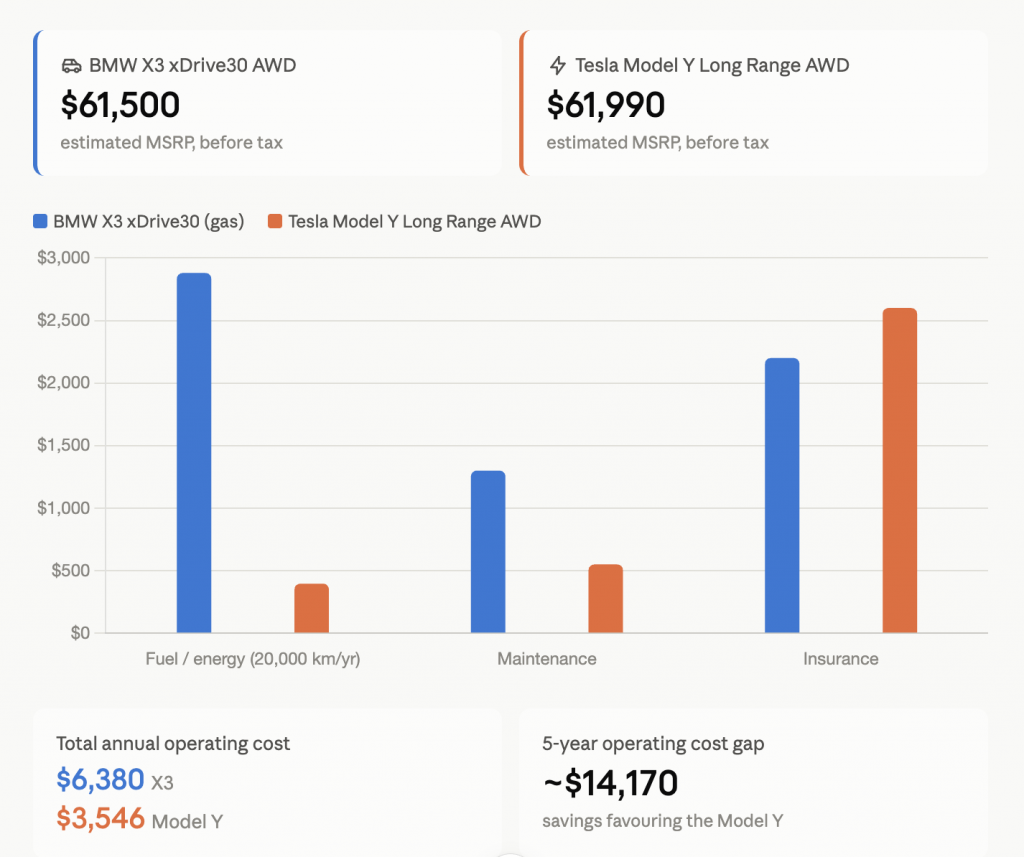
The financial case for owning one in Canada comes down to a trade: you’ll likely pay more upfront, but you’ll pay a lot less to keep it running. On the “fuel” side, the gap is dramatic — as of 2026, the average Canadian pays around $1.55–$1.69 per litre of gasoline, while home electricity averages roughly 12–17 cents per kWh nationally (ranging from as low as 7 cents in hydro-rich Quebec to closer to 18 cents during peak hours in Ontario). Run the numbers over a typical 20,000 km driving year, and a gas-powered compact car costs somewhere around $2,000–$2,600 a year to fuel, while an equivalent e-vehicle costs roughly $350–$550 charging at home — a saving of 75–90%.
On the purchase side, these still typically cost several thousand dollars more than a comparable gas model, and that gap has gotten harder to close recently. There have been rebates and incentives, both federally and provincially, which help close the price gap. Certain vehicles, like the Tesla Model Y, have seen price reductions. But generally, you will pay more for it.
On maintenance, these have the advantage: with as few as 20 moving parts versus 2,000+ in a gas engine, EVs skip oil changes, spark plugs, transmission service, and exhaust repairs entirely, and regenerative braking can stretch brake life to 200,000 km or more (roughly triple a typical gas car). Studies peg the maintenance costs at 40–70% lower than ICE vehicles.
So, does it make financial sense? For most Canadians who drive an average amount and can charge at home, the answer is increasingly yes — fuel and maintenance savings alone can run $1,500–$3,500 a year, enough to close the purchase-price gap within roughly 4–6 years of ownership, especially in low-electricity-cost provinces like Quebec, BC, and Manitoba. The math gets tougher in provinces with high electricity rates, for buyers who rely heavily on paid public fast-charging, or for anyone planning to sell the car before those savings have had time to add up.
Infrastructure
Charging is probably the issue that makes Canadians think hardest before buying one. If you can charge at home, it is remarkably convenient. Plug in when you get home, and the car is ready to go in the morning. Suddenly, you realize how tedious gas stations are! The catch is that not everyone has a garage or a dedicated parking space, and installing a home charger can require electrical work and additional expense. Public charging has come a long way since the early days of Tesla’s Supercharger network. Canada’s charging network has expanded rapidly, with federal, provincial and private operators building thousands of public charging stations across the country. Fast chargers are increasingly available along major highways and in urban areas, while networks are also growing in smaller communities. Still, Canada’s geography creates a difficult challenge: charging is generally strongest in major urban centres and in provinces such as Quebec and British Columbia, while rural, northern and remote areas can have fewer options and much greater distances between fast chargers. Public charging can also be more expensive than charging at home, and drivers still have to deal with broken equipment, crowded stations, payment systems and the time required to charge. Over the next five years, expect faster chargers, more reliable networks, more stations along major travel corridors and continued movement toward a common charging standard. The ideal future is not necessarily a charger on every street corner; it is a system where most people charge at home or work, and fast charging is available when they travel.
Does an EV work for you?
It tends to be the best fit for someone who has reliable charging access where they live, drives a predictable daily/weekly distance, and lives in a region with either cheap electricity, decent charging infrastructure, or both — think a commuter in Ontario, Quebec, or BC who does most of their driving around town and only occasionally takes longer road trips. It’s also a great fit for anyone who wants to minimize the hassle and cost of maintenance, cares about reducing their environmental footprint, or simply enjoys the quieter, quicker, more tech-forward driving experience this offers.
On the flip side, it is a tougher fit for renters or condo-dwellers without guaranteed access to home charging, people in rural or remote parts of the country where public charging infrastructure is sparse or unreliable, drivers who frequently tow heavy loads or take long trips through areas with charging gaps, and anyone on a tight budget who can’t absorb the higher upfront purchase price even with the fuel and maintenance savings factored in over time.
What’s Next?
So EVs are here to stay. And it can be confusing to see Ford cancel production of its respected F-150 Lighting EV, at the same time BMW announces that within four years at least 50% of its new car deliveries will be electronic vehicles. But the ranges are getting longer, the charging is getting faster, and many new exciting similar products will hit the market in the very near future. Are you charged up to get one?
Story you may be interested in: Ford Mustang Recall Exposes Quality Concerns