
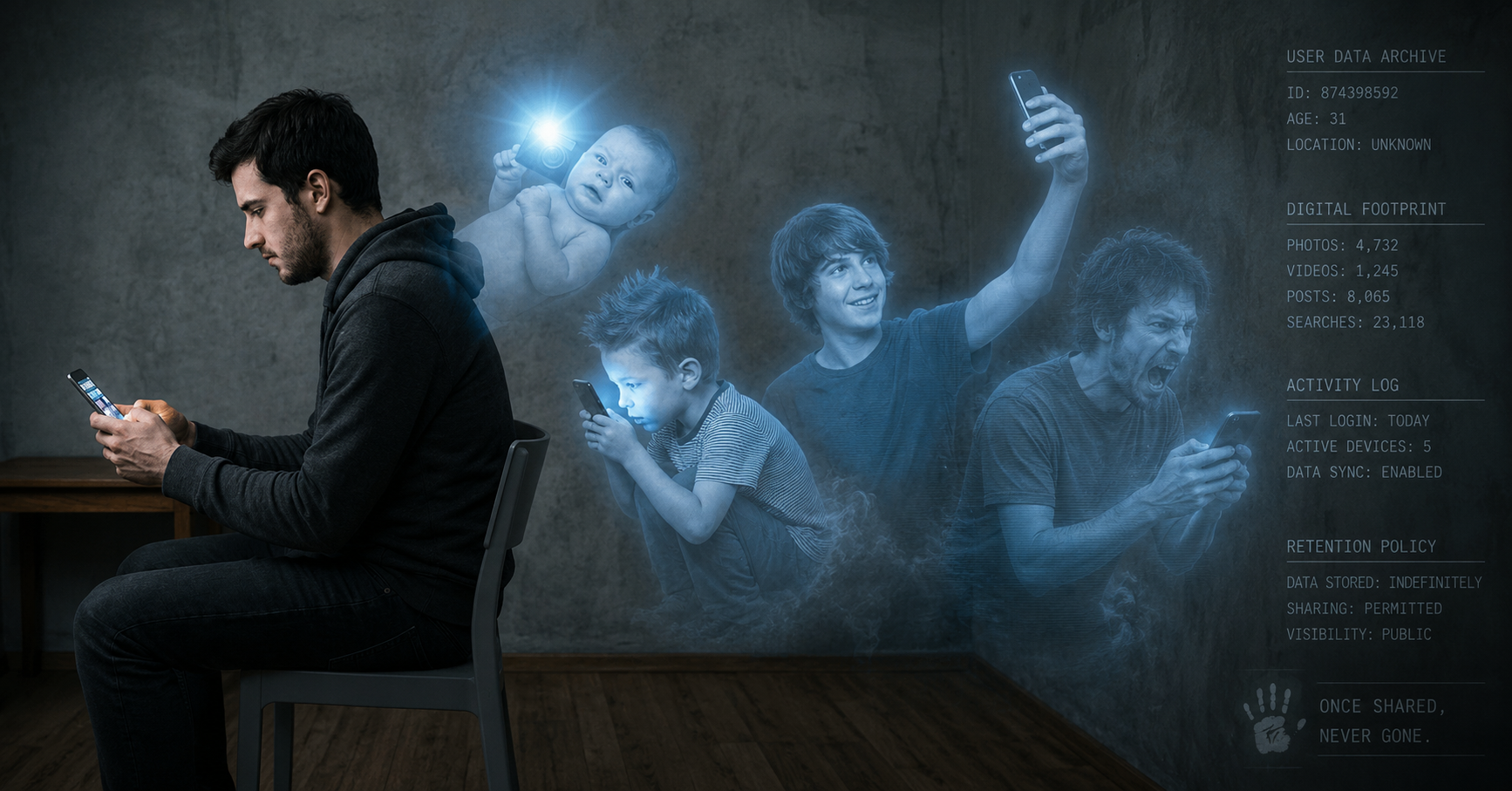
Let’s talk about the massive archive we are building (and leaving behind) every single day. Right now, millions of our memories live in the cloud – important milestones, private memories, and a few meals we’ve snagged a photo of for our Instagram story. While modern technology provides us the ultimate luxury of capturing an entire lifetime in the palm of our hand, is this always a good thing?
An extensive permanent digital web of our own creation. We’ve built an archived history that keeps our hands tied. Think about it; everything we have ever posted remains cemented somewhere online.
As this data continues to pile up, it forces an inevitable question: What actually happens to these images? Tech giants like Meta are forced to process a staggering 4,000 terabytes of data every single day just to keep up with us. Every text, every filtered photo, and every short video we upload becomes a permanent data point, adding to a colossal ocean of information stored in a server farm somewhere on Earth. Will the memories of billions of people wander through the cloud forever, or will they eventually decay into digital obsolescence?
The Myth of Deletion
For the casual scroller, this permanence might seem like a non-issue. But for a growing number of digital natives, it prompts a deep, creeping anxiety about the online ghost we leave behind. The old adage dictates that no one knows you better than yourself. Today, Mark Zuckerberg probably knows you best.
Algorithms are constantly cataloging your shifting aesthetics, your evolving interests, and your future aspirations. Recognizing this constant surveillance, a new wave of users has recently begun an aggressive process of digital purification—scrubbing old feeds and protecting privacy.
The Illusion of the Clean Slate
This digital purification feels liberating, but it rests on a fundamental misunderstanding of the modern internet. When we press delete, we mistake the removal of a visual file for the removal of our footprint. It is a ghost hunt. While an embarrassing photo might vanish from a public feed, the behavioural data it generated is already permanently hardcoded into your consumer profile.
The platform does not care about the content of your memories; it cares about your patterns. The image itself might be gone, but the data point tracking the exact millisecond you lingered on it remains. Long after the physical media is scrubbed, the algorithmic phantom stays intact—an invisible, mathematical ghost of who you used to be, cached by third-party brokers and stored in redundant backups. True erasure is a technical impossibility.
The Performance of Living (and Hoarding)
This illusion of control is compounded by a strange cultural programming: we have been trained to feed this digital furnace continuously. We can no longer witness a striking sunset without viewing it through a six-inch screen. At concerts, a sea of glowing rectangles records low-quality videos destined to be buried in storage and never watched again. At dinner tables, Instagram eats first.
We are suffering from a collective digital hoarding. When a single smartphone holds 50,000 forgotten photos, infinity dilutes meaning. We have reached a point of visual oversaturation where the exhausting act of documenting our lives has entirely replaced the quiet utility of actually living them. We are trading the raw, messy beauty of a fleeting moment for a static digital cache we will likely never open again.
When the Digital Ghost Haunts Back
This isn’t just an abstract tech dilemma or a case of minor digital paranoia; it has real, life-altering consequences. Recently, someone close to me applied for a visa, expecting routine approval. Instead, it was denied without any clear explanation. After digging deeper, we are certain the culprit wasn’t a paperwork error, but a ghost from the past: a casual, long-forgotten post on an old social media account.
It was a stark reminder that the algorithms aren’t just building consumer profiles to sell us shoes—they are gatekeeping our futures. A joke made years ago, an edgy phase, or a misconstrued opinion can be dug up by systems that completely lack human context. We might grow, evolve, and move on from who we used to be, but the digital gatekeepers have a flawless memory, and they don’t believe in character development.
The Right to Be Forgotten Digitally?
For previous generations, the mistakes of youth faded from physical memory. For younger generations, every stage of growth, our evolving opinions, and every embarrassing era is etched permanently in digital stone. Coexisting with our own digital ghosts is simply the non-negotiable tax of the modern age.

Reclaiming the Sovereignty of Digital Memory
How, then, do we take control back from the cloud? The answer might require a radical return to the physical. A small but fierce counter-culture is beginning to look backward to move forward—printing physical photo albums that can sit on a dusty shelf, using analog film cameras that force us to wait for a memory to develop, and intentionally leaving phones in pockets during major milestones.
True digital erasure may be a myth, but physical presence is still entirely within our grasp. The ultimate rebellion against our digital ghosts isn’t finding a better way to scrub our past online; it is choosing to let our present unfold completely undocumented.
Perhaps the true cultural challenge of the future is not learning to completely erase who we were. It is, instead, collectively adjusting to how we preserve what is important to us: Allowing us to continue writing our stories offline.
Subscribe to our newsletter for more news and updates in Canada.