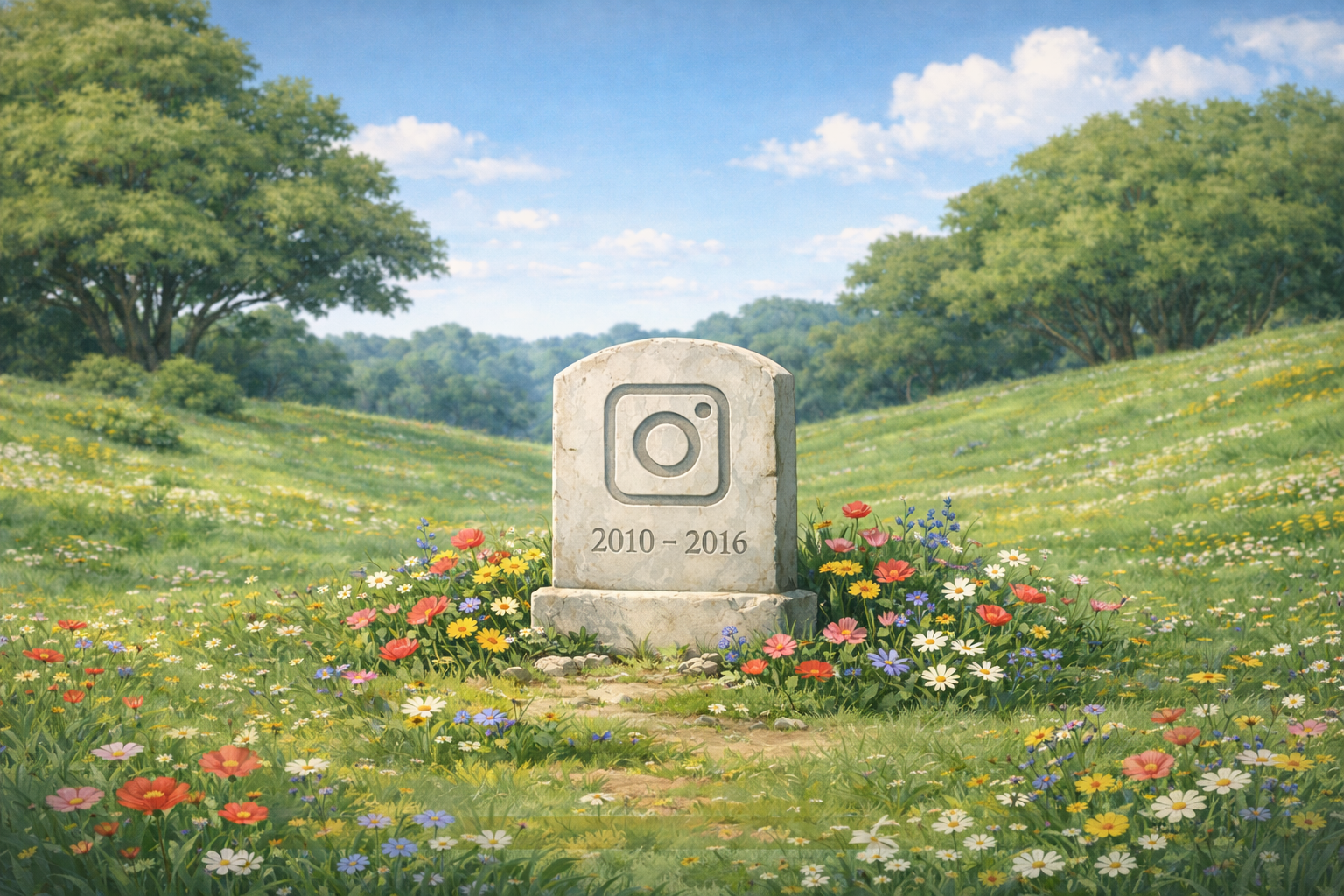
2016 was that time before we treated The Algorithm like some angry deity we needed to appease. The social in social media meant something. Here in 2026, Instagram is a completely different beast than it was a decade ago.
This 2016 trend blazing across social media feeds has been a fun way to visit our 2016 selves. Some of us were children then, now navigating the world as grownups. Some of us were just starting our careers, now we are three promotions deep and juggling family life. Some of us were already old and now just feel ten years older! We look back at a hairstyle or fashion item that either invokes nostalgia or makes us cringe. Maybe both! The personal transformations are amusing to see, but what about the transformation of the platforms that carry all these memories across the past decade? It’s actually a little shocking to examine how social media has transformed since 2016. Here in 2026, we accept the omnipresence of social media as status quo, but in 2016, the media landscape looked much different, and I’m not just talking about Snapchat filters.
First off, TikTok didn’t exist. As much as we all love to hate to be addicted to TikTok, my personal opinion is that the platform has ushered the end of human empathy and intelligence. But that’s another conversation! Twitter hadn’t been bought by Elon Musk; we know how that’s turned out. Vine was at its peak. Snapchat was for the cool kids. Facebook was around a decade old, the friendly elder statesman. It’s Instagram I want to talk about, though. I would argue IG is the platform that has had the most transformative effect on how we communicate and market.
2016 heralded changes that morphed Instagram from a true “social” experience into a multibillion-dollar advertising platform. 2016 was the final days of the innocence and authenticity which made Instagram successful from the jump.
Remember When Instagram Was Fun?
No stories, no reels, no carousels, barely any ads, chronological, worldwide. Hashtags were everything. The big new feature was being able to post a photo that wasn’t square. The word “influencer” wasn’t yet in the dictionary. This was Instagram as 2016 began.
When I discovered Instagram in 2014, I thought it was stupid. I couldn’t figure out who would care about random square images posted to an app. We already had Facebook, which seemed much more civilized. But then I discovered a niche community of nerds like me obsessed with watches. The #watchfam! Most people IRL had no interest in talking timepieces with me, but here on Instagram I could post pictures of my watch collection and get instant response from people who were hungry to talk about it. I started to gain “friends” all over the world: Singapore, Australia, Netherlands, USA, UAE, Brazil, Germany, Hong Kong, Tokyo, Spain, Malaysia. Every day, I was corresponding with the #watchfam. Many of these relationships spilled into real life. I could go to any corner of the planet and have a friend to meetup with.
That was just my niche. Dog lovers, foodies, fitness junkies, fashionistas, car guys, travellers, every kind of hobby or collectible; If you had an interest, there was likely a community on Instagram for you. If there wasn’t, you could create it!
Compared to now, it felt small, like you knew everybody in your particular niche. There were fun weekly challenges you could join, which allowed you to interact deeper with the community. You could deep dive into hashtags that grabbed your interest.
Real Influence
It was a new experience to feel like you were getting an inside look at what people enjoyed. There was an intimacy to the singular image. Just one photo, thoughtfully captured to share with a community. In the #watchfam, almost nobody showed their face. It was pictures of watches, the more creative the better. Your identity was your taste, your perspective, your awareness of the subject, and your skill with a camera. The watches were primary, but there was a bleed over into other shared interests: cars, spirits, pocketknives, fashion, food etc.
The word influencer was maybe tossed around. But we didn’t think of users with large followings as influencers. They merely had a large following because they had good taste and a unique perspective. More importantly, they were real people sharing their genuine interests. There was no flashy marketing campaign to see through. I found myself discovering all sorts of new (expensive) interests through the accounts I interacted with.
And it went both ways. I was good at this Instagram thing. Even with a small following, my pictures generated tons of likes and comments, always positive. I leaned into it, and as 2016 hit, I had over 30k followers. People wanted to know my opinions on certain brands, or where I got my accessories, or what I was getting next. Brands started to send me things; I began getting invited places.
Social Marketing Media
By the end of 2016 I felt like my “content” was better than ever, but somehow the fun started to fade. In the moment, I wasn’t analyzing why, but it just felt like somebody had turned the music down at the party. Now, in retrospect, we can look at some key changes that were made in 2016, which killed the social aspect of social media and left us with a big ol’ marketing platform in 2026.
Do you think that’s a cynical take? Look at the numbers.
In 2015, Instagram had about 500 million active users and brought in around 600 million dollars in revenue. By end of 2016, with 20% more users, there was a 260% jump in revenue, by some estimates. Here in 2026, IG has about 2 billion active users, and reliable projections put revenue in the range of 100 billion dollars. So, their user base has only quadrupled, but their revenues have grown 20,000%! So, good for them! But the joy of posting a pretty picture of our cat just ain’t what it used to be. But why?
2016 was the year of massive changes to the platform that took it from a quirky, user-driven photo-sharing app to an essential marketing machine. Let’s look at some of those changes and how they affected the user experience.
Geotargeting
To lay the groundwork for what was to come, in 2015, Instagram started using advanced geotargeting to allow advertisers to reach specific markets. This is when we began to notice our feeds becoming localized and started missing posts from friends in other parts of the planet.
Algorithms
Probably the most impactful change in the history of Instagram, in March of 2016, the Instagram feed became controlled by algorithms, abandoning the purely chronological feed. Thus began our obsession with “The Algorithm”. Before 2016, nobody was talking about The Algorithm, but in 2026, there is an entire industry dedicated to mastering it.
The move was presented as an improvement for user experience, personalizing and curating feeds to the user’s specific taste. But most Instagrammers who were on IG before March 2016 will tell you the experience was much better before the change. The true benefit of using algorithms is that it allows Instagram to segment and funnel what we see based on our preferences; powerful tools for advertising, especially when combined with geolocation.
For creators, algorithms create a miasma of uncertainty. Now, instead of just creating the content in the way they see fit, there is a list of parameters to be followed if they want their posts to be seen. In 2026 we accept it as the norm; are carousels the thing now? Do I hook them with the first 3 seconds? Am I using the right trending sound? But it was 2016 when this algorithm anxiety started. And the rules are constantly changing. We’ve all felt the thrill of hanging ten on that algorithmic wave, racking up views and likes that make you feel like you will be driving a Lambo within six months. Then, just as quickly, we get stuck in the back eddies of the platform, with posts that we spent hours crafting getting seven lonely likes.
Oh, but there is one way to guarantee you get eyeballs on your content: pay for it. With the introduction of the algorithm also came the ability to pay to boost posts.
The community feel of IG began to dwindle. Beyond the addition of new formats, the spirit of the content has changed dramatically. There has been an explosion of accounts designed purely to game the algorithm, relying on repurposing content and lacking any personality. Distinct creators pander to the algorithms. Despite the platform’s user base and revenue growing steadily since 2016, the engagement has consistently dwindled year over year. In 2026, there are more eyeballs, but the audience is increasingly passive when it comes to interacting with the content and creators. In other words, less social.
But the other thing The Algorithm does is keep us scrolling. It is designed to capture and keep your attention and predict what you will lock you in next. And it works. We’ve all had that numb feeling from getting off the toilet after 45 mins of doom scrolling.
Business Accounts
In 2016, we got business accounts with a full suite of analytical tools that work in concert with the evolved advertising functions of the platform. Many brands were already active on Instagram, engaging with the community in a largely organic way. The business account expands opportunities to grab audiences, especially if they pay to play. This was great if you are marketing a product or service. But it also signals that playtime is over, Instagram is serious business.
Video
Photos ruled Instagram at the beginning of 2016. But in response to other platforms like Vine and Snapchat, IG implemented several important changes which have directly evolved into 2026 Instagram as a primarily video platform. First, video posts got a bump in length from 15 to 60 seconds, which would eventually morph into reels. Next, we got the stories feed. Finally, Instagram Live. In 2026, all of these video formats play a massive role in online commerce. It’s cool. But today’s complicated, crowded, chaotic Instagram feeds are a stark contrast to the carefully curated photography of pre-2016.
2026
So…. sure, Instagram isn’t dead. Obviously, it’s a massively important platform for commerce in 2026. Yes, it’s still fun to share pieces of our lives in hopes that others will shower us with praise or admiration. But let’s be real, the social has been marketed out of social media. Instagram hasn’t been for us since the dawn of 2016.
Why are so many saying that 2026 is the new 2016? I think it’s because we need something simpler, less cluttered. We want community, connection, collaboration. We want to be off our devices and in the real world.
Experiential is the buzzword. Concert sales have exploded. There has been a resurgence in church/synagogue/mosque attendance. Broadway attendance increased 20%. Movie theatres are recovering. Sports fans are coming out in larger numbers every year. Parks and farmers’ markets and food truck festivals are packed.
If you have a brand to market this year, creating an experience is where it’s at. Savvy brands are already doing it; look at Capital One, Aritzia, Uniqlo, Ralph Lauren, all opening coffee shops to give their customers an immersive experience.
If you are just a human wanting to live your life, having an experience is where it’s at. And it doesn’t need to be tix to the Eras tour. Go for a hike in the hills, a bike ride across the city, a swim in the lake. Make dinner for your friends. Take your mom to a play. Go see stand-up comedy. Be in the world.
But whatever it is that you do, make sure you shoot a bunch of videos so that you can post a reel on Instagram later.